Clouds

August 23, 2020
(For Petey)

I watched the clouds all day
That day
The day you died

I sat outside
While
Lucy, just five, scootered in the driveway,
And Mike, he mourned with music
That poured from open windows

I gazed, craned my neck
Upward
Onward
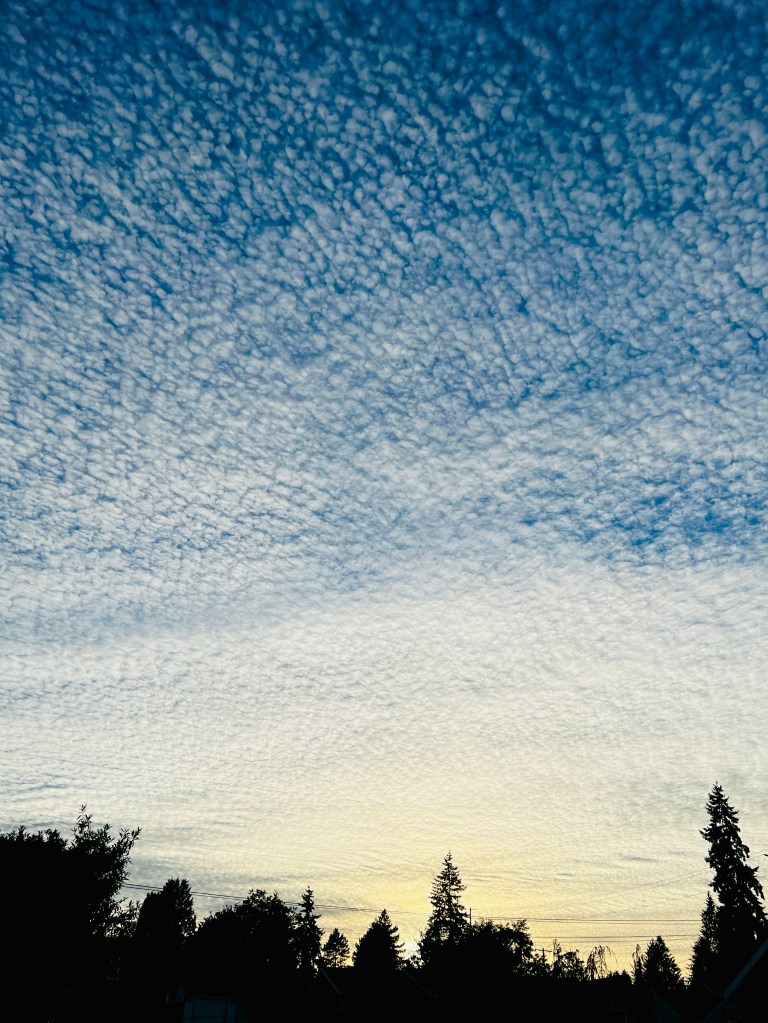
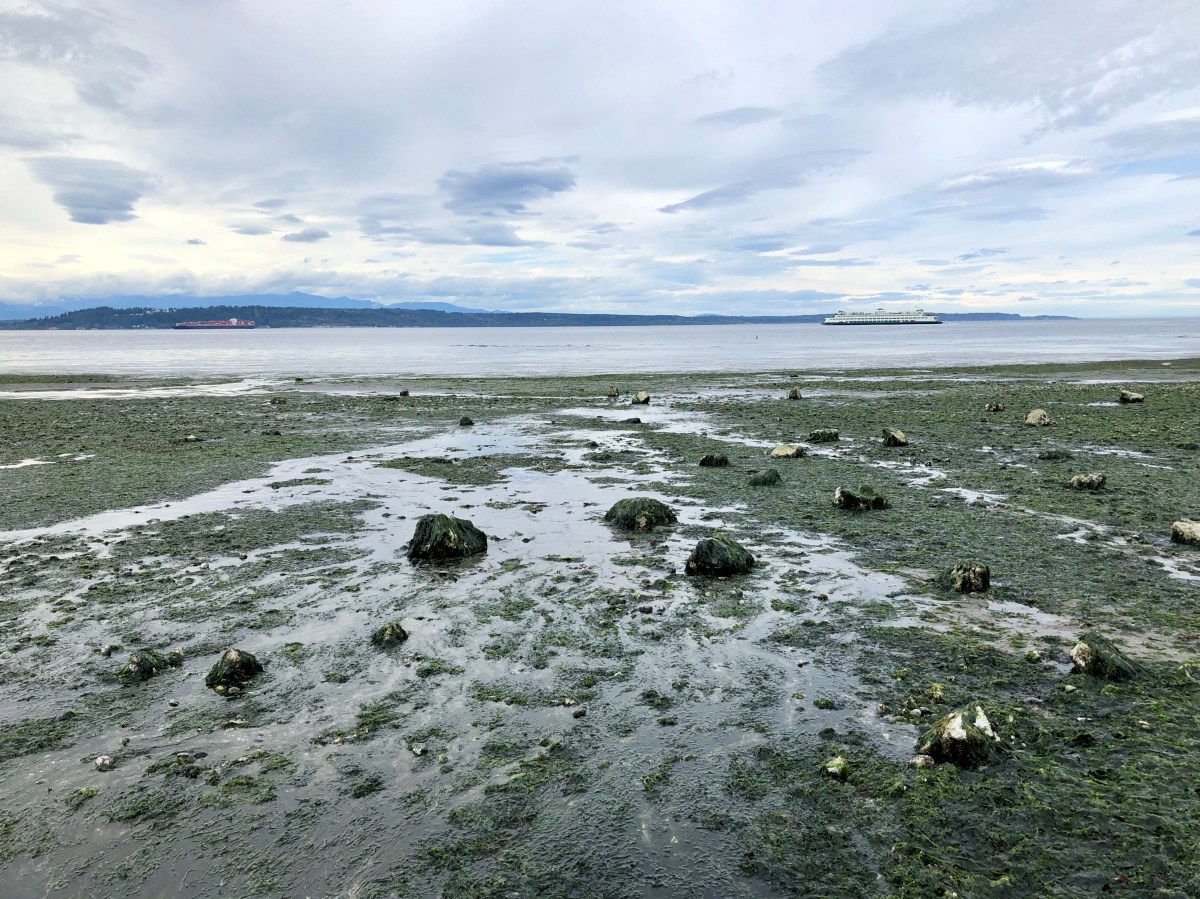
Witnessing the clouds
Seeking…

They shift like grief does 
And the other shapes of love
Ebb and flow, transform and reform;
Heavy sometimes, or feather-light
Ominously present, or barely there 
But there

Always.
And never
the same. 

Messengers

Who would I be
If I were free
Of the fear that keeps ahold of me?

An artist, a prophet,
A maker of love —
Singing my stories
With the birds up above

Seeing the violence
And hearing the cries
Feeling the suffering
Of life as it tries

Seeking the beauty —
Finding deep faith within
Naming the mystery
Of being human

Tender of heart
And firm of conviction:
We all deserve justice
And the peace that comes with it.

Surrender that fear
(Set her gently aside)
Say: I’ll bring you along
But I can’t let you drive!

We are artists and prophets
And makers of love — 
We have stories to tell,
And we need time enough

Revolutions and renaissance
A new world is there
If only we’ll nurture
The courage to care

Nine

Remember when she was small?

You rocked her to sleep in the quiet heavy dark

You stayed there longer, lingering

Later, you wrote to remind yourself: I sit in these moments. Do my best to, anyway.

Remember

Sit in these moments

Even as they speed up and splinter off and spill over

I can’t keep them

But I can stay there a little while

Linger

And taste know (sigh) every ounce — every ounce! — of love

Remember.

Each time it feels eternal, essential: singular

Because it is

And it isn’t 

And that is the good

that is God.

Remember

In the kitchen

I’m in the kitchen and I’ve burned the bacon for our sandwiches.

You’re in the next room on your iPad, doing I don’t know what.

Silently, automatically, almost subconsciously, I sink,
repeating the mantra of a programmed white woman:
I’m a bad mom.
Fucked up again.
Not good enough, never good enough.
Must try harder.
Confess, as if they were sins:
I smoke weed
I drink, maybe too much
I get lost in the suffering of this world
I’m distracted

But it’s a lie.
I’m not a bad mom.
And if you ask me (which you won’t),
Why is this bacon burned?
I will tell you the truth: because I care, my love.
I am paying attention.
I am seeing people erased in real time
And I care
And I’m scared
And I love you
And I love them
And I love all of us
And it’s not that hard to do why can’t we just Love?

Stop

Stop killing

Cease
Fire

I’ve burned the bacon
as if it makes one goddamn bit of difference!
We still will eat tonight.
I’ll take the most charred pieces,
Trying to shield you from life’s disappointments
In this and a thousand other absurdly tiny ways.
Knowing that I can’t protect you
But trying
Because I’m ashamed to face the weight of your pain.

I must face it! and that of all children everywhere
which is all of us, actually,
in order to stay human.
To transform.
To get free.

The truth is, even if we didn’t eat tonight,
Even if we lost everything,
Even if we lost each other,
I wouldn’t be a bad mom.

There’s no such thing.

There are only bad systems
Promising power
Dishing out poison
And telling us to like it.

Laundry


I meet God everywhere these days, which is lucky for me, because the devil is hard at work, too. Yesterday God taught me why I love to fold laundry. I don’t care much for the washing and the drying, or the putting away. But I savor the folding, and I think I know why.

I love to categorize

To find patterns

To tidy things into groups and put them in order.

It feels good.

It offers a small sense of control as I cling to this tiny rock, hurtling through a vast universe toward an uncertain future. I do like to feel in control.

So let’s sort the laundry:

These are yours, and those are mine

These are my going-out jeans

And here are my comfy clothes. 

These need some extra attention (a missing button, a rip, a stain)

And those have been outgrown and can be donated.

Here are the hard-working towels 

And the soft sheets that receive us at our most vulnerable.

Shirts to cover our tops

Pants to cover our bottoms

Underwear to shield our sexuality

Socks to keep our feet warm.

I love the feel of the different fabrics as I fold. I appreciate each piece, and I am grateful I can choose what suits the season, the need, the mood. Different styles and sizes and fabrics and forms. What a privilege to have such variety.

Sometimes I find myself sorting people into groups, too. Mostly I wonder which folks I can trust, and which ones might hurt me or my family. I assume so much, but people constantly surprise me, and my community grows wider every day. 

Unlike laundry, we humans have selves and souls, energies and emotions. Thoughts, opinions, myriad interests and experiences. Memory. Trauma. Story. All the things that make us alive. We grow and learn and shift and transform. We resist categorization. Reject it, even. We are far too complex. 

And, in all of our glorious, messy complexity—our diversity—we are whole, humanity.

Robust and vibrant

Beautiful and ever-evolving

With infinite possibilities for connection.

I meet God everywhere, but I see the devil, too. The devil tells us to be afraid of the mess.

I’m thinking of those who pull the triggers,

Those who have been taught to turn their fear into hate and their hate into violence.

I’m thinking of the banned books

And the banned history

And the banned art

And the banned identities 

And the banned people.

I’m thinking of Brother Jones and Justin Pearson and Zooey Zephyr 

I’m thinking of Ralph Yarl

I’m thinking of Elijah McClain.

I’m thinking of Jordan Neely. 

I’m thinking of a child who sees an unfamiliar insect and shrieks, “I’m scared! Kill it!”

No. I will not kill what scares me. And I will not kill what scares you. I will not fear what I do not understand. I will not assume that different is a threat to my existence.

I will notice. I will explore. I will learn. I will walk with courage toward justice and with faith toward community.

I will allow my self—and yours—space to breathe, and I will entrust the mess of us to God.

The laundry will be there for me.

Calvarium

This is a story about miracles.

It starts in December 2019, a few weeks before Christmas. I had just woken up from minor reconstructive surgery. I remember coming out of the anesthesia, hearing that everything had gone well, feeling relieved for about two seconds, and then immediately worrying about the routine scans I had undergone just two days prior. But I was too afraid to ask anyone if they knew anything, so I shuffled on home with my anxiety to wait.

I received my scan results by email a couple of days later. I was recovering, relaxing on the couch as my daughter napped on my lap, when my phone pinged. My CT results were ready. I took a deep breath, nervously opened the report, willed myself to read the radiologist’s words: stable, no evidence of disease. 

Whew. 

An hour or so later, my bone scan results arrived in my inbox. I opened this document more confidently, sure it would be fine. Eagerly, I scanned the report, settling my eyes on the “findings” section at the bottom of the page:

New focus of activity within the right calvarium is suspicious for an osseous metastasis. 

Uhhhh…what? I’m pretty well versed in anatomy, but I had to look that one up. 

My skull. My fucking skull. Are you kidding me?

I was devastated. For two years, I had managed to outrun my cancer, but apparently it had caught up with me.

I saw my oncologist later that week to determine next steps. The spot was in a tricky area for a biopsy. Radiation might be an option, but we needed to confirm the cancer was really there; there was a chance it was nothing. We needed more imaging. I acquiesced to a brain MRI scheduled for the day after Christmas. That scan was inconclusive, as was the CT of my head that he ordered next. 

We decided to wait and watch. I would have a follow-up bone scan in April—if it was clear, we could call the results from December a false positive; chalk it up to operator error. 

The months went by. I turned 40. Mike and I took a much-needed vacation. Lucy rocked pre-K. 

We started to hear more and more about a novel coronavirus that was moving through the country. We shifted into remote working and learning while sheltering in place. Plans were canceled. Appointments were canceled. Everything slowed down.

Everything except cancer. 

April arrived, with its blue skies and puffy clouds. We celebrated Easter and welcomed the cleansing freshness of spring. I had my follow-up bone scan, hoping desperately for good news. But the scan was not clear. Not only was the spot still there, it was more prominent. I had another MRI, which now showed a faint correlation and all but confirmed the progression. 

More treatment would be in order.

My radiation oncologist went over the plan with me. Thirty-plus sessions of daily radiation to my skull. Skin damage. Permanent hair loss. Possible long-term damage to my brain tissue. My relief at having an “easy” (read: non-chemo) option wavered as we went through the side effects.

But, as I told you at the beginning, this is a story about miracles.

The slow pace of quarantine days had brought my family to a new level of presence. We were noticing the patterns of the birds outside our windows and marveling at ants going about their work in the driveway. We were watching plants grow, observing berries on the mountain ash deepen their shade of red, ever so subtly, from day to day. One morning we saw a coyote loping down our normally busy street. The world was…quiet. Soft and still, full of wonder, even as fear and sadness loomed. 

Our lives had become quiet, too. So much so that I was able to hear the small voice inside that gave me pause—a voice saying, “Maybe not. Maybe it doesn’t have to be so harsh.”

And then one morning, as I was meditating, I had a waking dream—a vision. In it, I found myself in a serenely beautiful forest glade. From my vantage point, I could see a distant, craggy mountain range, domed by blue sky and skirted by evergreens, embracing a tranquil alpine lake. Surrounding the lake’s sides was a group of leafy deciduous trees, filtering the clear, golden sunlight as it shone down. I felt completely content, at peace.

In an instant, it was all destroyed; a violent explosion ripped through the woods, leveling trees, scattering wildlife, leaving charred destruction in its wake. I winced in pain.

As the image faded and my meditation ended, I realized that this perfect place was inside of me; it was me. I recoiled in horror to think of destroying this divine home with a nuclear bomb of radiation. It seemed impossibly wrong.

The next day I had an appointment with my naturopath. We discussed the treatment plan. I mentioned that I had asked about other options, specifically proton therapy, but that my doctor didn’t think it would be significantly better—maybe saving a millimeter or two of healthy brain tissue. My naturopath didn’t hesitate: “I think you should at least have a consult. I care about those millimeters!” 

I’m not usually one for second opinions. I trust my care team, and I love the convenience of the cancer center close to my home. But this time I went for it. Maybe it was the dream. Maybe it was the intuitive nudge. In any case, it felt like the right thing to do. The referral process to get an appointment took a few weeks. In the past, the delay would have terrified me, but my path had already taken so many strange turns that I was more curious than afraid. I had a calm sense that things were working out as they should.

When I finally got to meet (virtually) with the new radiation oncologist, she told me that proton therapy was a possibility but confirmed it wouldn’t be much different from the standard option I was being offered at my home hospital. Side effects and efficacy would be similar. She was not sure about the degree of potential brain damage, though, so she offered to bring me in to run a comparative simulation. 

In fact, she had time later that day. 

Turns out, she was an angel.

When I met with her in person, before going in for the simulation, she told me she had been looking over my scans and believed there was a third option. She had colleagues who performed highly targeted, specialized radiation to sensitive areas. It was high-dose, curative, precise. Instead of 30+ daily sessions, I would be looking at only a few days of treatment. She wondered if I’d be interested in a consultation? There was compassion, kindness, and intensity in the way she spoke to me. I could read her eyes urging me to say yes.

Um…YES.

I had an appointment with the specialist shortly thereafter. With this type of radiation, known as Cyber Knife, I would likely experience hair loss, but it would be temporary. There was no risk of brain damage nor any long-term side effects. The course of treatment would last just five days.

It was an easy decision.

It took another month or so to work through records transfer and insurance approval and scheduling and more scans and simulations, but I was free of anxiety because I knew, with every cell in my body, that I had been guided to the right doctors and the right treatment.

There were also plenty of other things to worry about. It was now late July. We were in the throes of the pandemic. Protests for racial justice had broken out across the country. As a nation, we were deep in collective fear and suffering. The world was no longer quiet or still. It was angry, chaotic, shouting, burning. We had reached a breaking point, and we were breaking. The future was unclear. America’s disease, it seemed, had caught up with it, too.

I began treatment. The first one was not easy; strapped down to the table by a mesh hood that covered my face and held my head absolutely still, I felt panicky, claustrophobic, and intensely vulnerable. I had to will myself: relax, breathe, DO NOT rip this mask off your face and run away. I needed mild sedation to get through the remaining four sessions. 

And then I was done. Nine months and a lifetime since it all began, and over just like that.

My hair started to fall out a few weeks later—triggering some PTSD from my early chemo days and leaving me with nearly half my head bald. I got used to wearing hats. I inspected my scalp daily for stubble. After about two months, I could see a faint shadow darkening the large, pale swath of my head.

On November 2, the day before the election, I received welcome news: my latest scans show that the radiation was effective. My cancer is quiet, healing.

My hair is coming in strong now, growing every day. I have a thick patch of fuzz. I like the way it feels. My husband and daughter drop kisses there often. 

Every day I look in the mirror and am reminded of my miracle.

Every day, I see that I was guided to just what I needed.

Every day, I see my capacity for growth and transformation.

Every day, I see that I am safe, that I can trust, that I don’t have to be afraid.

I don’t have to be afraid.

I see it, and I know it.

This is a story about miracles.
A way to begin

There is no protocol.

Racism is a cancer: this metaphor has come up repeatedly in the anti-racist reading I have done this summer, and it’s one that my husband and I have discussed often at home, even before George Floyd’s murder and the ensuing protests. (In a way, it’s a metaphor that saved our marriage, but that’s a story for another time.)

I am a white woman who lives with metastatic cancer and with internalized racism, so I’m drawn to the parallel. I want to explore the experience of coming to terms with both—especially since our current president has declared that it is anti-racist education that is actually the “sickness” in this country. (Spoiler alert: I disagree.)

To begin, let’s consider the onset. Both cancer and racism can go undetected for years. You may not feel sick, and it’s not your fault that you are. Hearing the words, “It’s cancer” can bring forth a surge of heavy emotions—or leave you feeling numb. Having someone call you out for doing or saying something racist can come as a big shock, too. I know, because I’ve been told both.

So you get a diagnosis. What do you do next? Do you ignore it? Deny it? Get angry? Cry? You probably do, at first. You might proclaim, “I’ve done nothing wrong!” or, “I did everything I thought I was supposed to do!” You might question, “What did I do to deserve this?” or, ”Why do I have to deal with this?” All valid feelings. But eventually, you will have to do something, because the disease is not going away on its own. Left unchecked, cancers spread and become deadly.

Fortunately, there are many resources available. You might start by seeking out expert opinions. Maybe you do some reading and research. Maybe you talk with people who have first-hand experience of what you are now facing. (Please be considerate, though, because these conversations can trigger real trauma.)

Once you’ve acknowledged your disease and done some learning, you will probably feel a little more confident about moving forward. Maybe you even start to feel hopeful. You probably still feel scared and angry and sad and confused and hurt and a little ashamed or guilty, but there’s hope, too, and curiosity. At least, that’s how it was for me. It’s all part of the process.

Next, in the cancer world, you and your healthcare team come up with a treatment plan designed to target the visible tumors and eliminate any microscopic cancer cells floating around inside your body. Likewise, when dealing with racism, you and your newly educated self start by calling out racist damage wherever you find it—or at least proactively considering the racist impact that your own words and actions could have.

You continue with your protocol for several months. The side effects might be awful, but you press on, because you know the discomfort is normal and necessary. Then, best case scenario, your scans are clear—you have no evidence of disease. If you have been actively learning about and identifying racism, you might believe you don’t have any of that left in you, either. You think, “Wow, that was really hard, but I did it. I got through it, and I’m better for it. I have a new outlook on life. I’m grateful. I’m ready to take on the world!” You might feel proud and happy, maybe even excited. Again, valid feelings.

And yet. You find that you have some nagging worry. Perhaps a faint doubt or a troubling sense of unease: Is it really gone? What if it comes back? And even if I no longer have to personally deal with it, are others still suffering? Are people continuing to die because of it? How do I feel about that? Do I care?

Chances are, you will care.

So you look for ways to alleviate your concerns. You search for guidance and inspiration, seeking out leaders, activists, and different voices. Maybe you donate your time or money to organizations that are working to eradicate the disease and support those most affected by it. Maybe you work to raise funds or awareness. You put all of your energy into fighting the disease. You do a lot of good.

It never feels like enough, though.

And one day, you realize with dismay that you have been acting out of fear this whole time. You have been resisting and suppressing your disease. Running from it, breathless, hoping it doesn’t catch up with you. You wrestle with the idea that you might never be able to get away from the disease. It’s always there, whether you see it or not. This new awareness causes a great deal of stress and anxiety, because it is rife with uncertainty and a lack of control. You don’t know what to do, because there is no protocol for this part.

So you stop running. And you get brave, and you turn around. 

What you see surprises you. Where before there was fear, now there is love. Where before there was self-preservation, now there is compassion. Where before there was resistance, now there is acceptance. And you understand that instead of suppressing your disease, perhaps you can transform it.

You begin to see your disease as a symptom of something much bigger than poor luck or unfortunate circumstances. Maybe this illness is not so much an individual problem as it is a societal issue. Maybe our environment is sick. Maybe our systems are sick. Maybe our policies are sick. Maybe the people in power suspect—or even know—that these factors are making us sick, but they benefit too much to do anything about it.

Maybe if we acknowledge that we are all sick because our whole structure is sick, and we demand change and we hold our leaders accountable, we can begin to get better. 

We cannot undo the past, but we can move forward differently. 

We can go in love, rather than in fear.

Racism, like cancer, is complex in its origins, pathways, mechanisms, and manifestations. Racism, like cancer, has a way of hiding, growing, recurring, and metastasizing without our being fully aware of what’s happening. Racism, like cancer, is the sickness, and right now our entire country is grappling with metastatic disease. There is no protocol, no cure. But we can move forward and heal anyway. We can get better and do better anyway. Anti-racist work, like anti-cancer work, is a way to begin. 

I am no longer afraid of facing either my cancer or my racism, nor of getting it wrong. There is no protocol, and I cannot control the outcomes. What I can do is learn, listen, think, consider, feel, try, mess up, have setbacks, learn something new, listen harder—hear, think some more, reconsider, feel differently, and try again. 

There is no protocol. But I love myself, my fellow humans, and the promise of this democracy enough to face my disease anyway—trusting that doing so enables me to get better and to do better, too.

Making space

My heart is breaking into a million pieces.

One week ago, my family was dealt a tremendous loss. My cousin Petey was the best. So loving and very loved. Hilarious and fun. Compassionate. Earnest. Protective. He was so full of life that he sparkled.

I learned in May that he had been diagnosed with cancer. Four months later, he was gone. He was only 40.

My grief is heavy, and feeling the pain of those closest to him and witnessing the outpouring of love, shock, and support from his friends and family compounds it a thousand times over.

I miss him terribly.

And then I wake up to the anguish of a community mourning the unexpected loss of a real-life superhero to cancer.

And then there’s my own cancer.

And the pandemic.

And Black people getting shot in the back. And in bed. And in cars. And on the street.

And so much fear and hate and staggering hypocrisy.

But also my baby niece was born.

And my own child overflows with health and happiness.

And my marriage is solid after coming close to collapse.

And there’s a movement for justice that is happening and will not be stopped.

And the sun shines and the birds sing and the flowers bloom.

How are we supposed to hold space for all of this? It takes my breath away. I feel raw and exposed, by turns giddy and depressed. I cry often, simply from the overwhelming crush of what it is to be alive right now.

I also feel strangely free, untethered from the limitations of my physical body and cut loose from certainty of what’s good and what’s bad. My rigid expectations of how life is supposed to go are fading. I am unconcerned with other people’s judgments and no longer interested in making many of my own.

I have so much inside of me. Every one of us does. Oceans of pain, joy, suffering, hope, frustration, creativity, darkness, humor, fear, LOVE. Our experiences are unique, but we share in our humanity, in our capacity for big emotions, for resilience, for growth, for curiosity, for transformation. For giving and receiving help. For connection. For empathy.

We have the ability to see each other–and to see ourselves in one another.

I’m done being afraid of who I am. Done pretending to be small. I’m done with being “fine.” I just don’t think I have room for it any more.

I’ve decided that I’m going to let my ocean spill out in waves–the pain, the joy, the suffering, the hope, the frustration, the creativity, the darkness, the humor, the fear, the love. The struggles and the triumphs. The humanity, all of it. Because it’s what’s real in a world of mirages.

I’m going to let my humanity shine, and I promise to honor yours, too. Maybe it’s the way forward–to see and be seen as we are, as human beings who are doing the best we can to navigate the waves of our oceans.

My heart is breaking. But in breaking, it is also expanding.

I am making space for it all.

Floating

Several months ago, I quietly celebrated the two-year mark since my metastatic breast cancer diagnosis. I didn’t do anything special, just prepared myself for the waves of emotions and allowed myself to feel them. Allowed myself to feel tremendous gratitude for how far I have come and where I am now. Acknowledged the hard work I have done, as well as all that I have left to do. Remembered how very lucky I am.

Allowed myself to think back to that day, the day I got the call. Allowed myself to grieve.

July 29, 2017, marked the beginning of a new way of life. A shift, a breakdown, an awakening. It was 8:30 a.m., on a Friday. Mike was home, had taken the day off because we had plans to head out to the beach house for the Mettler Classic, our annual family golf tournament and gathering, named for my grandmother, who loved a good party. Lucy lay asleep in bed between us. I was awake, expecting the call. 

I’d had a biopsy of a 1.4 cm lesion on my right hip bone earlier in the week, and I was waiting for my oncologist to deliver the results. Several weeks prior, I’d asked for a bone scan because of an odd discomfort in my leg and an unsettling feeling in my gut. I’d been responding well to chemo, the tumor in my breast had shrunk significantly, and I had surgery and radiation scheduled. I was in the home stretch of my treatment. But something didn’t feel right, and so I asked for the scan. I figured if it was clear, it would alleviate my anxiety and help me finish strong. I could get through my last couple of infusions and focus on getting well. I wanted to put my fears to rest.

But the bone scan was not clear. So my doctor ordered a PET scan and a biopsy, and here we were, waiting for the results, hoping, expecting, even, that they would be negative, that the blip was some old injury or a cyst or something that had been there for years. The PET scan showed low metabolic activity in the hip lesion and no additional areas of concern: great news. So we were just waiting on the results of the biopsy.

My phone rang on my bedside table, and I picked it up.

“Good morning, Dr. Kundra, how are you?”

“I’m good, I’m good. So the biopsy…it came back positive, actually.”

“Oh.”

Not good, not good, not good. Panic setting in, heart racing, eyes welling up. What does this mean? I know what it means. A nightmare. Metastasis. Stage 4 cancer. I’m going to die. I have to be on chemo for whatever is left of my forever. I’m never getting my port out. I’ll never be well again. What about my family? What about Lucy? I’ve let everyone down. I’m so sad and so ashamed and so disappointed. And so scared. Oh, my God. 

And then, emptiness.

My doctor rattled off some more information, used words I couldn’t process, asked if I had questions.

“Not right now,” I answered.

I hung up. Let it sink in, head down. Breathe. “It’s cancer,” I told Mike. Lucy snoozed away, sprawled out across the bed. My precious, barely two-year-old, girl. What would become of her childhood?

“Huh.” And he held me, hugged me, let me cry.

I got up, called my mom. Asked her to please let my dad and sisters know, because I couldn’t. Cried some more.

We decided not to go to the beach. I didn’t think I could handle being around so many people, not with this huge unknown hanging over me. I didn’t want to talk about it, didn’t want to darken the weekend of fun. I wanted to stay home, where I felt safe.

Mike got up and went to the store. He came home, inexplicably, with a dozen doughnuts, something we never have. Fuck it, I thought, and ate one. Let Lucy have one all to herself. What difference would it make?

Somehow we got through that day, and the next. Mike and I went to a baseball game that Sunday. The Mariners were playing the New York Mets, and I commented on the strange coincidence of that matchup…my home team battling the Mets while I took on my own personal mets. I took it as a good sign that my boys won that game. Glimmers of humor, of hope, beginning to shine through cracks in the walls of my fear.

In the weeks and months that followed, I researched, read, learned, talked, planned, and moved forward. I advocated for myself. I convinced my doctors to proceed with my full treatment protocol, including surgery, radiation, and reconstruction. I implemented a number of complementary therapies to support my overall health. Somewhere along the way, I found hope again. And, unexpectedly, I began to feel excited and happy and even grateful for the position I was in and the path ahead. I began to believe that I was going to live.

And day by day, I did, and I am. Alive. Living. Some days I barely survive, others I thrive. It’s okay. I struggle with fear. A lot. It makes me anxious and impatient and short-tempered. Sometimes I feel depressed, sometimes I feel explosively angry. Sometimes I feel isolated and so alone. Sometimes the fear makes me lash out at the people I love most. I make a lot of mistakes. But I have a lot of help, and the fear fades. I reflect. I learn. I apologize. I talk about it. I reconnect with my people. And I have moments of utter peace, of complete contentment, of deep joy and wonder for my miraculous life. 

I am learning that these big emotions come and go, that we have an unlimited number of chances to pick ourselves up and forgive ourselves and try again. That the people who matter will love us, even through our lowest, most vulnerable moments. That I deserve that love and that I can give that love to myself, too. I guess that’s resilience, though it feels much more awkward in real life, in the thick of it, than it does when you read some sparkly inspirational quote about never giving up.

Lucy swim

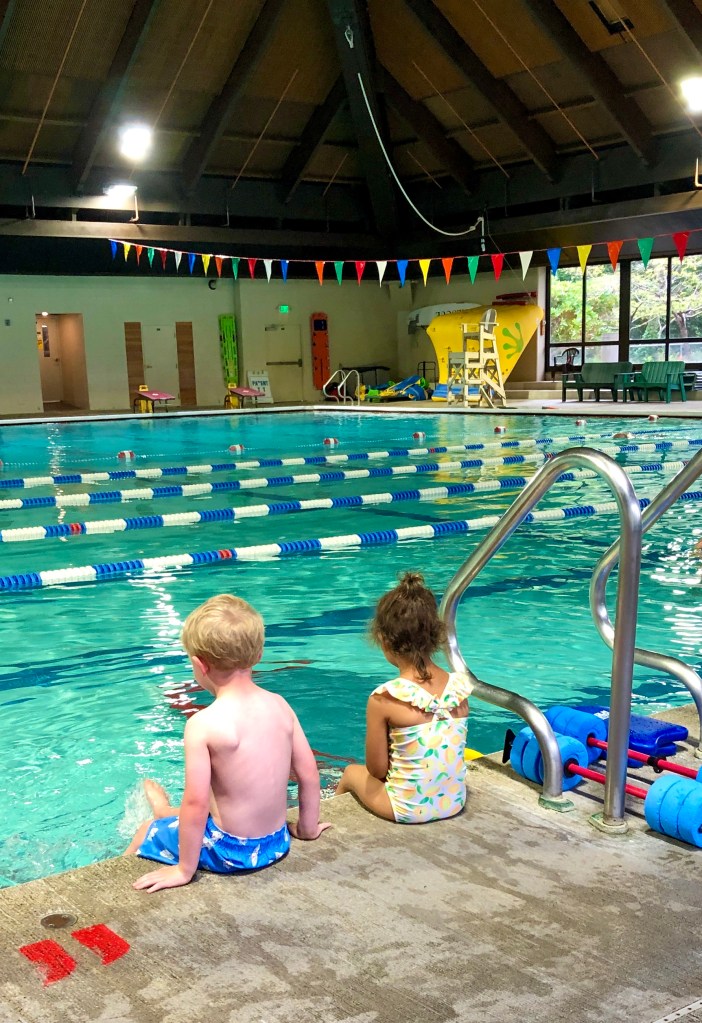
I was watching Lucy at her swim lessons last week, noticing how she goes rigid when she’s practicing her floats, even though her teacher tells her to relax. Sometimes she panics, kicking and splashing, trying desperately to keep her head above water, forgetting that she’s held, that she’s completely safe. It strikes me how like life her practice is. The more we try to tighten, grasp, and control, the more afraid and anxious we become, and the harder it is to find peace; we sink. But when we relax and trust—even thought we may be scared—we find ourselves carried, cradled by the currents of the universe, by God, by whatever it is that supports us and keeps us afloat. 

I’m practicing too, at this very moment, as I heal from my most recent surgery and await my latest scan results. Although I’ve enjoyed good health and no evidence of disease for nearly two years now, I still find myself grappling with fear, with the unknown, with the “what-ifs.” I’m fighting to keep my own head up when deep down I know that I’m protected, buoyed, and propelled by love, hope, and faith.

There is so much beautiful uncertainty in life, and our landscapes are always changing. Maybe the trick is to get comfortable with that truth, to find freedom in it, to let go and float.

What it would repair

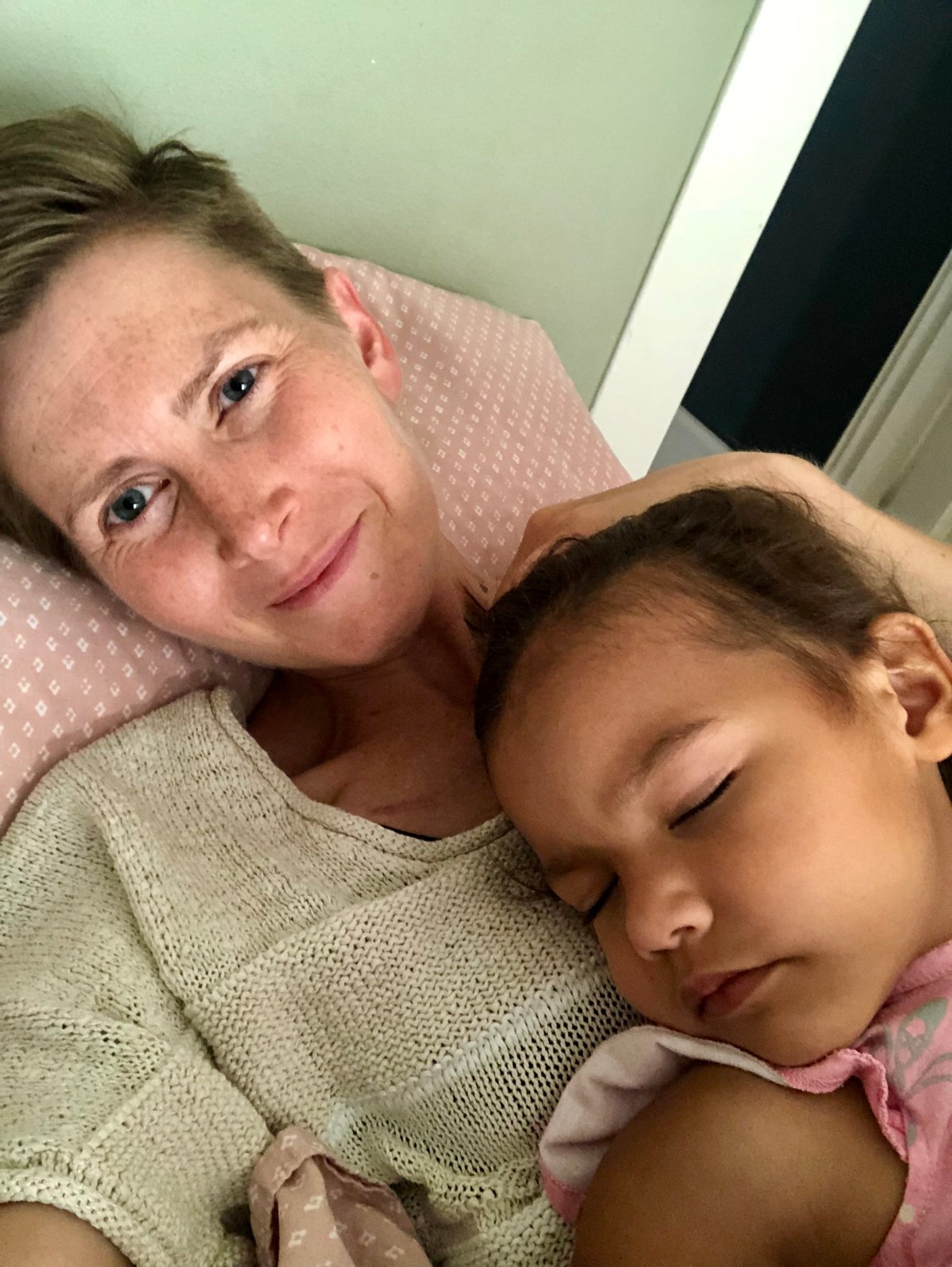
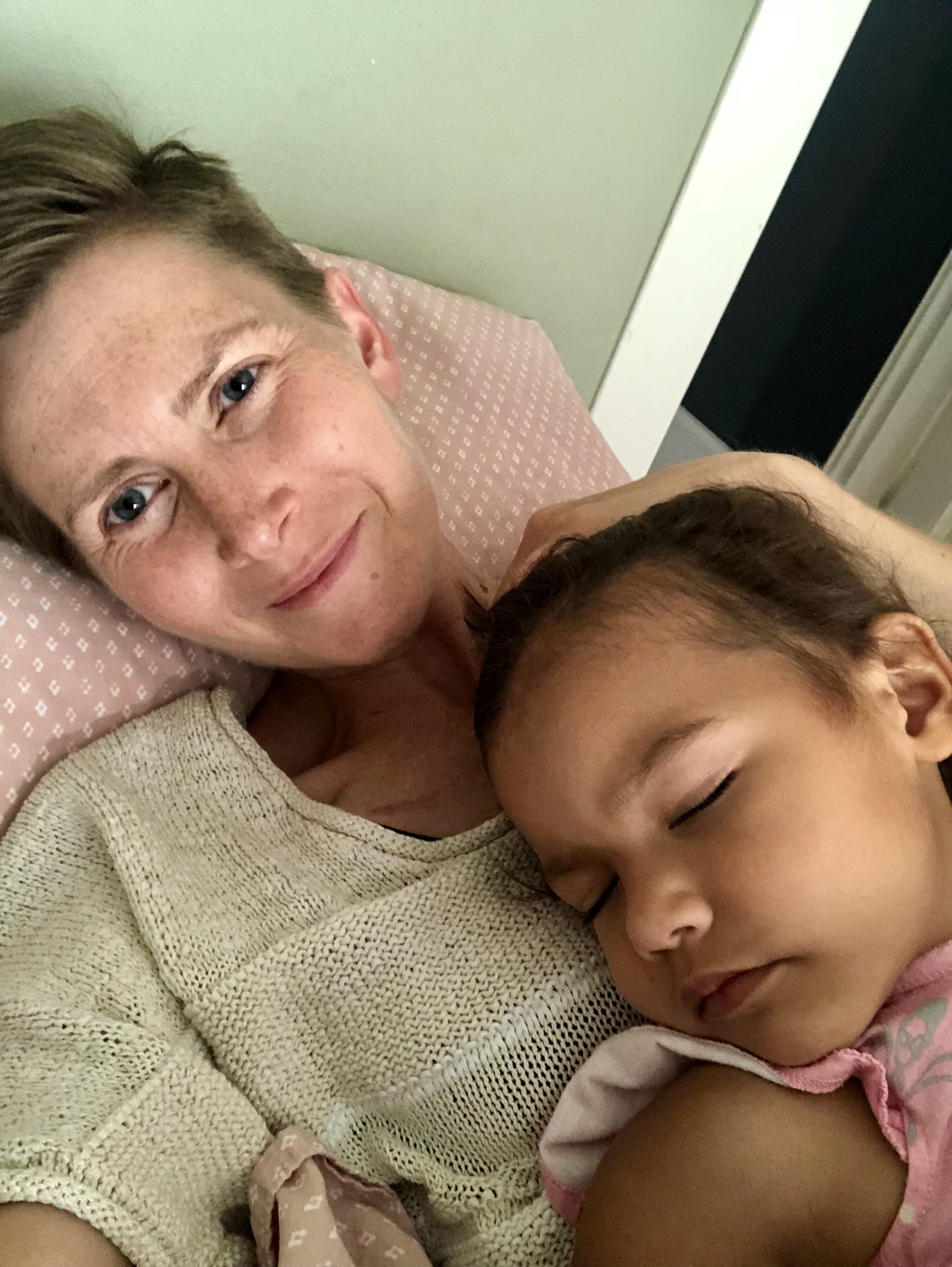
About a week ago, Lucy fell asleep with her head on my chest for the first time in nearly a year. I lay there in her little bed, holding her as the old lullabies played, and I cried. I cried with grief and relief and joy, all at the same time. Such a simple moment, but something I have missed so much.

From minutes after she was born, Lucy found the ultimate comfort nestled against my chest, falling asleep there, often sneaking her hand down my shirt to feel the soft warmth of my skin. And I found my way as mother with her at my breast, nursing her on demand for 20 precious months and cradling her against my heart day and night. Cancer ripped that comfort and closeness away from both of us, first when I had to wean her before starting chemotherapy and then again when I underwent a mastectomy to remove as much of my remaining and potentially treacherous breast tissue as possible.

That loss, the premature severance of a physical bond between mother and child, has been the hardest and most painful part of this entire experience. It is the part that makes me cry when I think back over the last year and half. It is the part that feels unfair. It is the part that–I’m ashamed to admit this–brings envy every time I see a pregnant or nursing mother. I am beyond (beyond!) grateful for the months I had with Lucy when she was an infant, and I love her even more now, if that’s possible. Feeling strong and healthy and happy enough to truly enjoy this present time with her is the biggest blessing.

But still. I grieve the loss. It was unexpected and traumatic and it sucked.

My mastectomy was in September of 2017, and the post-op healing process took several weeks. When I was finally able to hold Lucy again, she struggled to be comfortable. Where there had been softness, a natural pillow, there was now barely more than bone covered by a thin layer of skin. She would turn her head this way and that and squirm, never complaining, but not content. I would lie with her at night to help her fall asleep, and she would lie on top of me, wriggling around until she found a soft spot on my belly on which to rest her head. We got used to it, but it always felt a little awkward and sad.

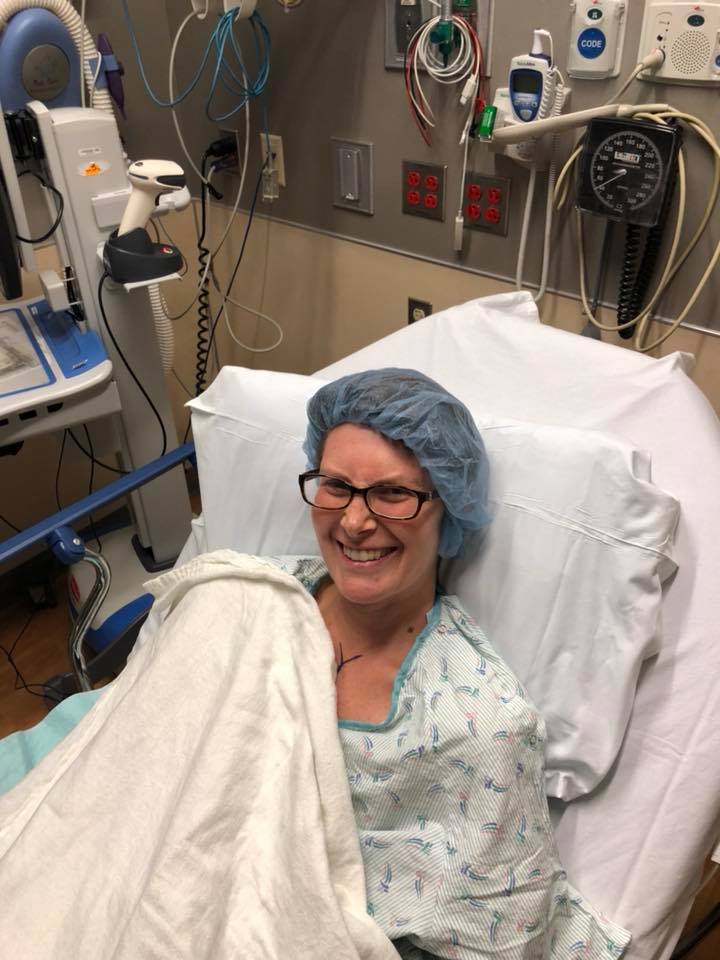
Six weeks ago, I had reconstructive breast surgery. My husband posted a goofy photo to Facebook: me, drugged up, in surgical gown and cap, with a caption about celebration and #tatas. We may think of plastic surgery as a casual choice, even a vanity. Maybe we joke about enhancements and touchups. And while there was certainly a welcome element of that lightheartedness and humor going into my surgery, it was tempered by the gravity of why it was happening and the hope of what it would repair.

I was in the operating room for nearly 12 hours and in recovery for three additional days–by far the longest hospital stay I have ever had. I now have a slash across my abdomen that stretches from hip to hip. This is where the surgeons harvested skin, fat, and blood vessels with which to build new breasts. I have oval-shaped scars outlining my new “girls,” scars from tape blisters, scars from various drains, wires, and tubes. After surgery, I couldn’t stand up straight, raise my arms, or lift, push, or pull anything more than 10 pounds for weeks. Everything hurt.

You might be thinking, “All that for new boobs? Sheesh.”

I get that.

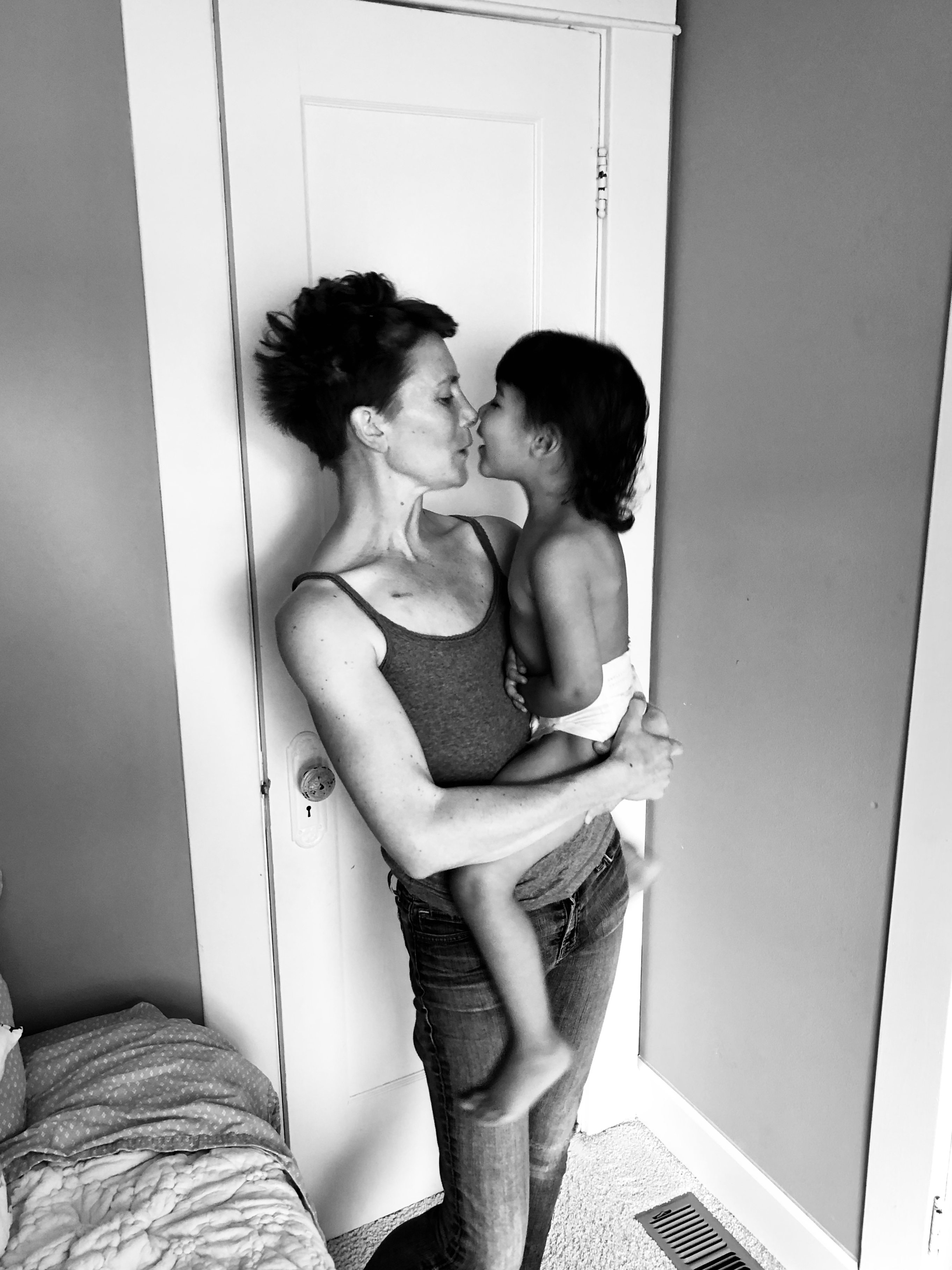
But now clothes fit the way they should, and I feel more confident in the way I present myself to the outside world. When I look in the mirror, I no longer see cancer. I see scars and strength and beauty. And Lucy once again has a place to rest her head. That is what I wanted most of all.

She’s getting so big. And that’s awesome because every day she grows is a day I get to experience and appreciate. But I also want to hold my baby close a little longer, before she’s all grown up and I’m out of chances.

And now I can.

fullsizeoutput_16af
The day before my breast reconstruction.

36620565_10212578376036530_4520587417027084288_n
Ready for the OR.

IMG_7694
Six weeks post-op, feeling whole again.